Connect with us

City League

Coaches weigh in as PIAA board approves steps to incorporate diagonal system of officiating, scraps extra time from regular season

This is typically a very slow time of year when it comes to High School soccer in Pennsylvania.

However, with some interesting developments that have taken place in the past month, this is a good time for a the first edition of High School Soccer Notebook for 2026.

There have been two very interesting changes that will be coming to PIAA boys and girls soccer starting this Fall, as the PIAA Board of Directors made decisions to approve two measures that will bring the game closer to the way its played in most other levels throughout the world.

Those two changes include scrapping of extra time (or as most casual observers would call overtime) from regular season matches and a transition to start to incorporate the diagonal officiating system that is the world standard.

Add in the news that Highmark Stadium will be hosting PIAA Championships from 2026-29 — on a proper soccer-only facility — and as our friends from Philadelphia Soccer Now pointed out recently, the PIAA is catching on.

Pittsburgh Soccer Now also conducted a survey of WPIAL (PIAA District 7) and City League (PIAA District 8) coaches to get their thoughts on numerous offseason developments.  We will be posting more feedback and survey results soon, but in the meantime, we also included some coaches reactions to the changes that are coming.

Additionally, one other item we’ll be watching, is WPIAL will be finalizing realignment of its boys and girls soccer classifications, with an announcement expected to come very soon.

It’s Official: Extra Time Scrapped from Regular Season

Beginning with the 2026-27 season, the PIAA shared after its January Board of Directors meeting, that it is eliminating overtime for all regular-season high school soccer games.

What does this mean for regular season, WPIAL section matches?

All regular season contests tied after 80 minutes of regulation will end in a draw. This rule change applies to both boys and girls soccer, with the goal of improving player safety, reducing physical fatigue, and preventing late-night games.

When the postseason commences at the District (WPIAL and City League) and State (PIAA) tournament, all matches tied after 80 minutes will feature two extra time periods.  If they are still tied after two extra time periods, the match will be decided by a penalty kick shootout.

Some coaches weighed in on this change with differing opinions.

While the majority (nine out of 11 girls coaches and five out of eight boys coaches, 14/19 overall) believe it was the correct decision, there were a few who offered a compromise, suggesting that Section contests be allowed to have extra time, but not non-section matches.

“I think it is best for player safety, especially in a grueling season with often not enough recovery time between matches. To play an extra 20 minutes is a lot. My team has had seven games in the last two years go to overtime with about half of them ending in a draw,” Jordan Curcio, Riverside Girls Head Coach, said and added: “It may be beneficial for a team that thinks they can sit back and defend and take a team to a draw. So, it may change the dynamic of the game a little bit. I think it would have been better if they made this adjustment specifically for non-section games. It is ridiculous to force non-section teams to play double overtime when the results don’t matter. My team gave up a goal in a non-section match at the beginning of overtime last year just to get out without injury before playing a section match the next day and having dead legs.”

Bethel Park Boys Head Coach Doug Fink agreed: “There are too many matches in a short amount of time to begin with (sometimes 3 matches a week). It makes sense to eliminate Extra Time during the regular season when we don’t get home on the bus until 10pm or later after certain away matches.”

“There are already too many required games in a condensed season without proper time for recovery between games,” Andy Folmer, Bishop Canevin, Girls Head Coach added.

“Especially for 1A teams with small sides, the lack of recovery time between games is a major injury and health risk for players and does promote an atmosphere where student-athletes are able to compete to their highest potential. The elimination of regular season overtime is at least one small measure that actually puts some demonstrative action behind the overused and cliche “safety is our top priority” mantra from PIAA and the respective districts (who then turn around and tell a team with a roster of 11 to play double-headers just for the sake of ‘getting games in’).”

It makes sense to eliminate the overtime period. The late nights could already be bad enough at times for away trips, that was only compounded by the overtime periods,” Alexander Guie, Laurel Highlands boys Head Coach, said.

“Additionally eliminating overtime periods aligns with how our sport is played throughout the world.”

Seton LaSalle’s boys Head Coach, Nick Balzer is among those who sees both sides.

“Extra time/Golden Goal carries a special meaning that regular season games simply cannot bring. I can understand it for section games, but if it’s an all or none proposition, the correct call was made.”

“Overall I think no extra time during the regular season will help the players with recovery and load management,” JC Mahan, Avonworth Girls Head Coach pointed out, but also added: “I will miss the many memories that sudden goal OTs have produced in the past, some of the best memories have come in those scenarios.”

“I didn’t think the extra time was all that long,” Andrew Kariotis, Burrell’s Boys Head Coach, shared.

“I wouldn’t mind if it was section games only getting OT – I like to see a winning team when possible.”

Diagonal System of Officiating Proposal is approved to be incorporated into PIAA

During this Wednesday’s scheduled PIAA Board of Directors meeting, a recommendation was made to amend the adoption of PIAA Soccer Officiating Mechanics to Modify Rule 5-1-1, as the Board amended the adoption of PIAA Soccer Officiating Mechanics to Modify Rule 5-1-1, to use both the dual and diagonal system of officiating.

“I’ve been waiting for this for 24 years (as long as I’ve been coaching in western PA),” Doug Fink, Bethel Park Boys Head Coach exclaimed.

“It makes sense to have one head referee to maintain a level of consistency for 80 minutes.”

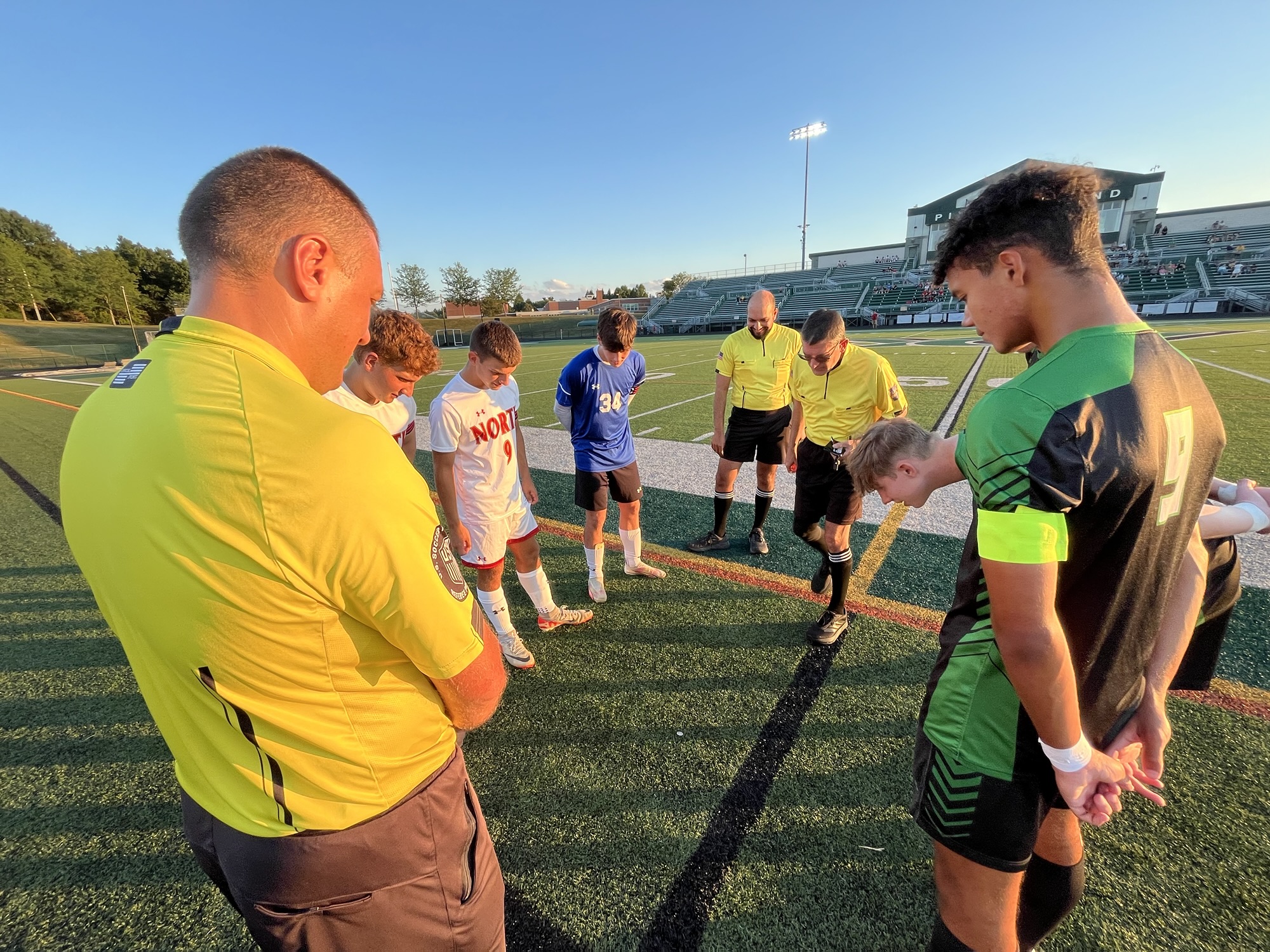
The primary differences between diagonal and dual officiating in soccer center on the number of officials, their positioning, and the authority they hold. The Diagonal System of Control (DSC) is the international standard, using three officials (one referee, two assistant referees) for high-level control.

The Dual System uses two officials with equal authority, often employed in lower-level, youth, or high school games due to referee shortages or budgetary constraints.

Feature Diagonal System (DSC) Dual System
Officials 3 (1 CR, 2 ARs) 2 (Both with whistles)
Roles Specialized (1 Referee, 2 Assistants) Equal (Both can call fouls)
Movement Referee follows a diagonal path Both follow a lead/trail, “scissor” pattern
Offside Controlled by ARs Difficult to judge accurately
Application Professional/Competitive Amateur/School/Low-level

Many coaches shared concerns about this transition year and addressed the continuing referee shortage in the WPIAL.  Some believe that many officials who have opted not to work high school games because of the duel system, will start to show more interest in becoming PIAA officials.

“There is a clearer line of responsibility and communication and an opportunity for better positioning from the ARs within the diagonal system versus the double dual,” Andy Folmer, Bishop Canevin Girls Head Coach said.

“Most soccer referees are used to the diagonal system from working USSF games, so I think it will be a very good point of progress.”

“With one whistle, the players get a better feel for what the tolerance of the one whistle is. Also, this gives more experienced – or top referees – the ability to mange the game,” JC Mahan, Avonworth Girls Head Coach said.

“The ARs (assistant referees in diagonal system) have an easier job of assisting and really worrying about offside and out of play calls. Lastly, proper signals (flags) in the game that align with international standards make the game more relatable/understandable.”

Riverside Girls Head Coach Jordan Curcio feels that it’s a positive change, but ultimately believes that consistent and improved communication between officials is paramount no matter what system is in place.

“The pro’s are that many small schools including my own only have used a 2 man system over the years which has not made for consistent calling. If the rule ensures that there is a 3 man system, I think it is good. I don’t know that I have ever encountered a 3 whistle system. What would probably alleviate a lot of issues is if each crew had Coms to discuss. I often hear refs that see something from one angle that another didn’t and them being able to discuss it provides in my opinion the most consistency. The center doesn’t have to accept the advise, but ultimately it benefits everyone if they have the ability to communicate. I think that is more important than a 3 whistle system.”

Josh Pajak, Girls Head Coach, Southmoreland, believes the pros outweigh the cons but has a few lingering questions, though it appears that if there are only two officials at given matches, they will use the duel system.

“No cons other than can schools get three officials? If they cannot, what is the system? I would imagine MS games would remain a 2 man system.”

Road To Highmark now includes PIAA

In addition to these transitions, Western PA soccer scored another big win when PIAA awarded Highmark Stadium to host all eight State Title contests over a two day period on November 19 and 20.

Highmark Stadium tabbed to host PIAA Boys and Girls Soccer Championships

PIAA Soccer Key Dates and Schedule Guidelines (2026)

  • August 16 — First Practice Date
    • Minimum Length of Preseason Practice 2 weeks
  • August 21 — First Inter-School Practice or Scrimmage Date
    • Maximum Number of Regular Season Inter-School Practices or Scrimmages 2
  • August 27 — First Regular Season Contest Date
    • Maximum Length of Regular Season 10 weeks
    • Maximum Number of Regular Season Contests 18
  • November 6 — Last Regular Season Contest Date and District Deadline
    • WPIAL Playoffs (TBA)
    • District 8 / PIAA Play-In (TBA)
  • PIAA Boys and Girls Soccer Tournament
    • First Round November 9
    • Quarterfinals November 13
    • Semi-Finals November 16
    • Finals
      • November 19 — 2A & 4A Girls’ and Boys’ Soccer Championships  (Highmark Stadium)
      • November 20 — 1A & 3A Girls’ and Boys’ Soccer Championships (Highmark Stadium)


John Krysinsky has covered soccer and other sports for many years for various publications and media outlets. He is also author of 'Miracle on the Mon' -- a book about the Pittsburgh Riverhounds SC, which chronicles the club, particularly the early years of Highmark Stadium with the narrative leading up to and centered around a remarkable match that helped provide a spark for the franchise. John has covered sports for Pittsburgh Tribune-Review, DK Pittsburgh Sports, Pittsburgh Sports Report, has served as color commentator on Pittsburgh Riverhounds SC broadcasts, and worked with OPTA Stats and broadcast teams for US Open Cup and International Champions Cup matches held in the US. Krysinsky also served as the Head Men’s Soccer Coach at his alma mater, Point Park University, where he led the Pioneers to the first-ever winning seasons and playoff berths (1996-98); head coach of North Catholic boys (2007-08), associate head coach of Shady Side Academy boys (2009-2014).

More in City League