The Riverhounds started off a busy week with a 1-0 loss at Birmingham, with an uninspired effort, lacking quality in the final third even with a change-up in formation (4-2-3-1) and a lineup designed to bring more firepower from the start
Head Coach Rob Vincent shared his thoughts after the match, believing that it was an even contest against a club desperately seeking its first win of the season.
“I think it was a relatively even game overall. We probably got into some positions we wanted to higher up the field, particularly in the second half, areas we like to be in. But the final quality was lacking today,” Rob Vincent, Riverhounds Head Coach stated after the match. “Eliot (Goldthorp) hit the post with the good strike, but a lot of the crosses didn’t hit anybody. They took one of the few chances they created, and we’ve got to be able to find one on our end.”
With this result, this was Pittsburgh’s (2W-3L-1D) first loss to Birmingham since 2022 and the Legion FC’s first win of the season. Pittsburgh has now started the season with just one win in five road league matches and have yet to post a shutout in league play.
With this match in the rearview mirror, the Riverhounds now put behind the most difficult road stretch of its league schedule, but still have to navigate extra travel with a mid-week Open Cup opportunity in New Jersey on Wednesday to face NY Red Bulls, then return home for a quick turnaround to face Detroit at Highmark Stadium.
There’s no doubt that in his first full season at the helm, Vincent and the Hounds are facing early season hiccups.
Birmingham 1, Pittsburgh 0 — Match Takeaways
Tactical Shift Meets Final Third Frustration
In an effort to spark the attack, the Hounds transitioned to a four-man backline and a five-player midfield featuring Robbie Mertz, Eliot Goldthorp, Danny Griffin, Sam Bassett, and Jackson Walti.
While the shift helped Pittsburgh maintain a tight possession battle (49%) and generate 1.14 xG to Birmingham’s 0.68, the clinical edge was non-existent and there were times as if when they were getting into the final third in several transition moments, they were not always on the same page. Ultimately, Pittsburgh were unable to force Jassem Koleilat into a difficult save all match.
In its tactical Shift, the Hounds may have inadvertently isolated Albert Dikwa. Because Bassett and Goldthorp were often tracking back or drifting wide to find the ball, Dikwa spent much of the first half as an island instead of coming back for the ball and getting involved earlier in the attack.
As a result, throughout the first 45 minutes, the Hounds’ two leading scorers, Dikwa and Bassett, barely registered a meaningful touch in the box. When crosses did come in—like the Perrin Barnes delivery in the 23rd minute—Dikwa was forced to take difficult, low-percentage header attempt with a pair of defenders step-for-step with him, because there was no secondary runner to draw away the Birmingham center-backs.
Interestingly the only time we saw Dikwa heading into the box unmarked in the first half, was when Goldthorp drew defenders on his left side of the box when coming in transition. Goldthorp managed to unleash a blistering shot that banged off the right post, where Dikwa stood without a defender anywhere in sight. While Goldthorp nearly ripped the side netting out with that shot, in hindsight, if he took something off that attempt and saw Dikwa bolting for the back post — it could have been a clinical, header finish opportunity for Chico.
The disjointed attack may have seen its most glaring moment following the first pair of substitutions in the second half that included Max Viera coming on for Perrin Barnes, when Robbie Mertz executed a perfect turn at the edge of the box, then played a weighted ball toward the end line, expecting Viera to make an overlapping run. However, Viera remained stationary and faded out wide while the ball rolled harmlessly out for a goal kick.
This sequence was emblematic of the afternoon—a good idea met with a lack of telepathy between teammates.
Despite matching the hosts with 10 shots, the Hounds managed just one shot on target all afternoon.
There were more crosses than we’ve seen Pittsburgh send this year in any match (a big 33-7 edge), but they didn’t do much with all that service (ending the match with 21 percent crossing accuracy vs 42 percent for Birmingham — who converted its goal on a cross).
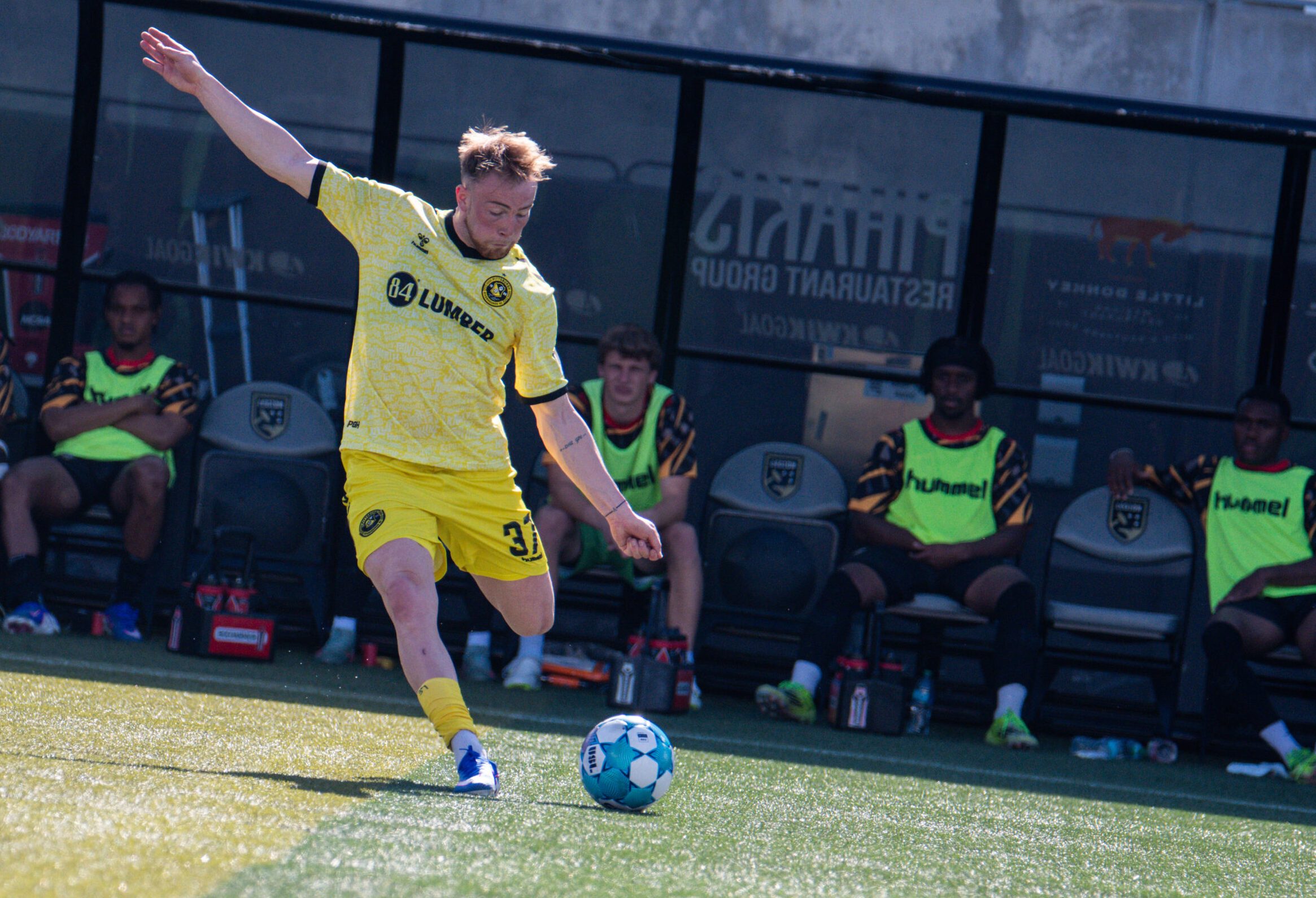
There were missed opportunities on set pieces too. Despite earning several corners and free kicks in dangerous areas, the final quality Rob Vincent alluded to was missing from the service. For example, in the 87th minute, with a chance to steal a point, Sam Bassett uncharacteristically sailed a 25-yard free kick high over the bar. Similarly, in the dying seconds of stoppage time, two consecutive set-piece deliveries from Mertz and Bassett were easily cleared by the first defender, failing to test the keeper when the entire team—including the aerial threats of the backline—was forward in the box.
Sure, the Hounds are getting in some of the right areas, but on Sunday they didn’t do much beyond that. This is a recurring theme as the Hounds struggle to convert build-up play into genuine danger.
Vincent didn’t seem as concerned in his post match comments. To be fair, this was the first time he started a match with the 4-2-3-1 formation and it was the first time Mertz was in the eleven following a preseason injury as he’s worked his way back into full match fitness coming off the bench in previous league match appearances.
The first 90-minute performance of the season was a noticeable one for Mertz, with two chances created, winning possession a team-leading 10 times and succeeding on 5 of 8 duels. He was also second on the team with 10 crosses and connected on 12 of his 14 passes in the final third.
The Early Deficit Pattern
For the fifth time in six league matches this season, the Riverhounds conceded first and were forced to chase the game.
While the team has shown resilience recently—securing a road win and a draw after trailing in previous weeks—playing from behind is a dangerous habit that finally caught up to them in Alabama.
The 25th-minute goal by Sebastian Tregarthen forced the Hounds to navigate a stout block for over an hour, proving that they cannot consistently rely on late-match heroics to overcome slow starts, particularly on the road.
Even though Birmingham had struggled this season to pick up a win, Head Coach Jay Heaps has been building a club that’s intent on making it difficult for opponents to score as they’ve now only allowed one goal in three home matches this season.
The concern for the Hounds with allowing early goals could be a little deeper, though Vincent has downplayed the trend as a series of isolated defensive moments rather than a tactical failure,
Riverhounds have been masters of dictating the terms of engagement. A typical Hounds performance through much of the club’s success has seen since 2018, includes securing an early lead and then utilizing a rigid, suffocating defensive shape to force opponents into low-percentage mistakes. By falling behind in 83% of their league matches this season, they have surrendered the ability to dictate pace.
Instead of the opposition playing into a Pittsburgh trap, the Hounds are being forced to navigate stout blocks (like Birmingham’s on Sunday) for 60+ minutes at a time.
3. Defensive Identity Crisis: Still No Clean Sheets
Historically known for defensive rigidity, the 2026 Riverhounds have now gone six league matches without a single clean sheet.
To find a similar defensive drought, you have to look back to the 2016 season—two years before the Bob Lilley era began—when the club went six consecutive league matches without a clean sheet (from May 21 to June 25, 2016) — when the club fired Mark Steffens and replaced him with Dave Brandt as Head Coach.
By comparison, in the 2025 campaign, the Hounds never went more than three matches without a shutout. They recorded eight clean sheets overall last year, including a notable stretch where they kept three in a row during April and May. In 2026, the Hounds have already conceded 11 goals in 6 league matches. For a team that historically bends but doesn’t break, failing to record a single shutout by mid-April marks the most difficult defensive start the club has seen in a decade.
While Vincent noted that the backline of Kelp, Souza, and Mikoy has looked solid overall, the inability to keep a zero on the scoreboard is putting immense pressure on an attack that is already struggling for goals or having to play from behind. The past two weeks, the Hounds have just surrendered one goal, but each coming early in matches (last week it was a penalty).
With the Hounds winning just one of their first five road league contests, finding a way to lock down the defensive third will be essential if they hope to turn these narrow travel losses into points.
To be fair, the previous two seasons, Pittsburgh also struggled early in terms of overall goal differential. This season, it’s not a good trend with the Eastern Conference competition heating up this season, the Hounds may face an uphill battle to get into an essential top four finish.
Here is how the first six matches of this season compare to the early struggles of the past two years:
Comparison: First Six League Matches
| Season | Record (W-L-D) | Goals Scored | Goals Allowed | Goal Diff | Clean Sheets |
| 2024 | 2–3–1 | 5 | 7 | -2 | 1 |
| 2025 | 3–2–1 | 7 | 8 | -1 | 1 |
| 2026 | 2–3–1 | 8 | 11 | -3 | 0 |
No Time To Sulk
The road-heavy start to the 2026 campaign has undoubtedly been a trial by fire for this evolving Riverhounds squad. While the eye test and statistics from Birmingham highlight a team still finding its rhythm, there is reason for optimism as the calendar turns.
The Hounds have a massive opportunity to hit the reset button this Wednesday night (April 15) in the U.S. Open Cup Round of 32.
Facing an MLS opponent like the New York Red Bulls offers the perfect stage for the Hounds to reclaim their defensive identity and prove that their tactical flexibility can translate into a giant-killing performance on a national stage.
Perhaps more importantly for the league standings, the Hounds are finally coming home. After spending five of their first six league matches on the road, the team returns to Highmark Stadium this Saturday, April 18, to face Detroit City FC. That match kicks off a crucial stretch where they will play four of their next five league matches on the South Shore.
Historically, the Highmark turf has been the place where the Hounds’ defensive prowess is restored and the final-third chemistry is forged.
If they can parlay the lessons from this difficult road trip into a strong home stand, a top-four finish will start to look a lot more manageable.
Upcoming Key Matches
-
April 15: @ New York Red Bulls (U.S. Open Cup R32)
-
April 18: vs. Detroit City FC (Home)
-
April 25: vs. Greenville Triumph (Home)
-
May 2: vs. Phoenix Rising FC (Home)


PSN’s Featured Community Partner: Open Field International



Pittsburgh Riverhounds
The Ultimate Playoff Hurdle: Hounds to face postseason nemesis Lou City FC


Pittsburgh Riverhounds
USL Championship Atlantic Division Preview: Familiarity breeds contempt