Perched atop Herron Hill, overlooking the steel-and-glass skyline of the Golden Triangle, Ambrose Urbanic Field has quietly transformed over the last decade into one of college soccer’s undeniable cathedrals.
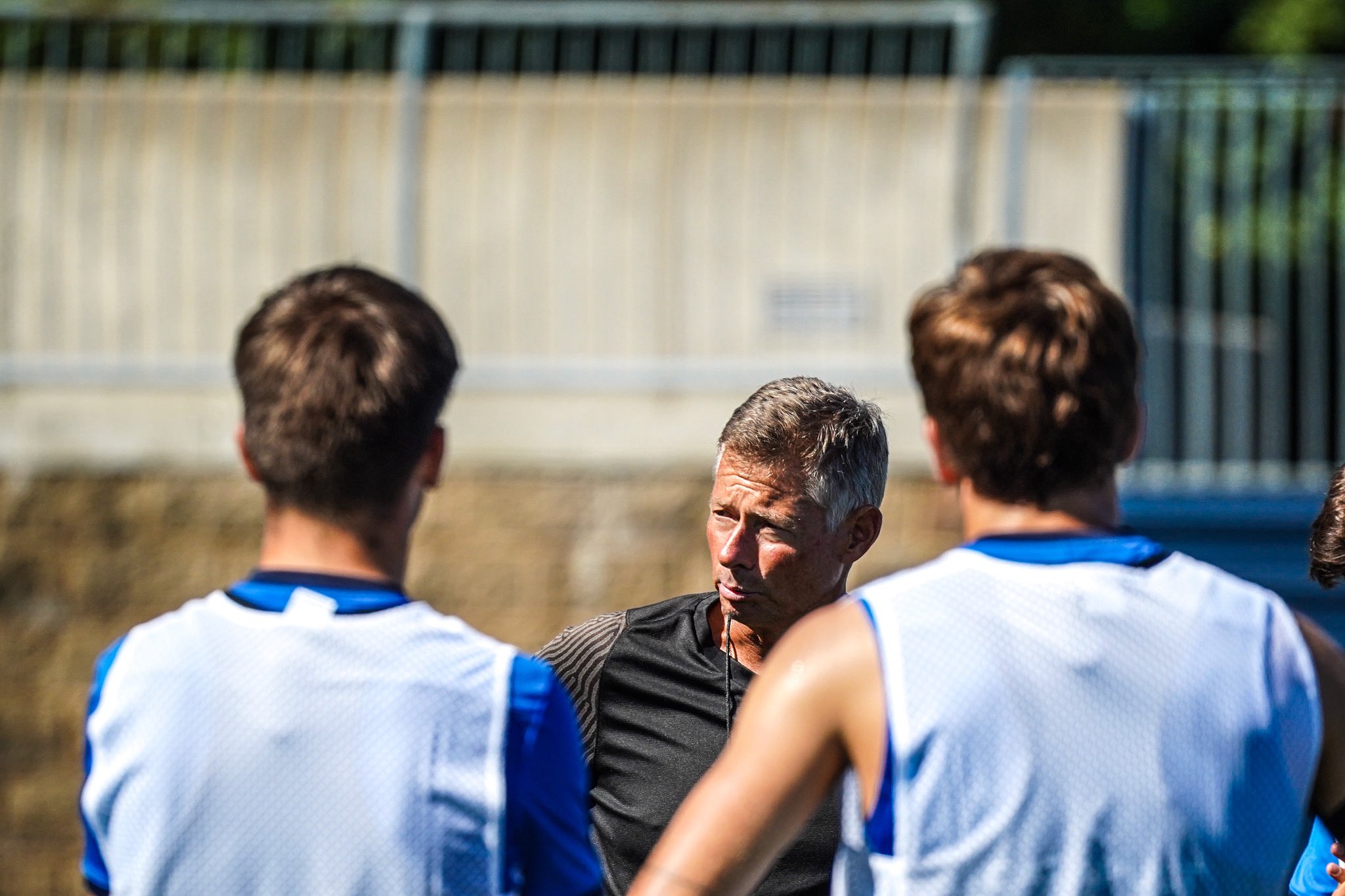
Alongside Randy Waldrum’s unprecedented rise with the women’s side, Jay Vidovich built Pitt men’s soccer brick by brick through elite technical standards, relentless ball retention, and a fierce, uncompromising brotherhood.
Yet, as Vidovich steps onto the turf this week to inaugurate his 10th season on the Panther sidelines—fresh off a contract extension—he does so with the quiet, calculated edge of a builder who knows the engine needed an overhaul.
For the first time since 2018, the NCAA Tournament bracket was unveiled last November without “Pittsburgh” written on a line. In a league as ruthless as the ACC, missing November’s big dance by the thinnest of margins wasn’t just a disappointment; it was a rare, jarring recalibration for a program that reached two College Cups and four national quarterfinal appearances in a four-year span.
Now, on the eve of the 2026 campaign, which starts with a real stern test vs No. 7 Maryland at Ambrose Urbanic Field on Thursday evening, Vidovich isn’t shying away from the reset.
He’s leaning into it.
The Culture Carrier: Logan Oliver’s Unfiltered Standard
To understand where Pitt is going in 2026, you first have to understand the man who’s experienced the ups and downs of high level college soccer experience and will be one of the Panthers locked in the middle of the pitch: Logan Oliver.
Oliver’s journey to Oakland wasn’t linear. A blue-chip talent out of the Philadelphia Union Academy, Oliver redshirted his freshman year at Indiana without logging a single official minute. When he entered the transfer portal, the first phone call he received was from Pitt.
When Oliver arrived for his winter visit, the campus was empty. Sitting across a desk from Vidovich, there was no standard recruiting fluff, no guaranteed starting spots, and no promises of glory.
“I’ll never forget it,” Oliver recalled during a recent appearance on College Soccer Central. “Jay brought me in and said, ‘I need you to change the culture. I need you to help drive our culture.’ There wasn’t much talk about playing time. It was: We’re a talented team. We’ll help you with the soccer part, but we need your help with the locker room and leadership.“
That blunt transparency bonded Oliver to Vidovich immediately. Today, the senior midfielder stands as a vocal, battle-tested warrior whom Vidovich openly credits as the bridge between the coaching staff and a locker room carrying 11 new additions.
“Logan is just a warrior,” Vidovich said. “A tremendous leader. He’s part of a core group that paid the price, saw what it was like not to have the success we expect here, and figured out just how much work you have to put in to win in this league.”
Oliver sees a distinct shift in this year’s group compared to teams of the recent past.
“In the past—like last year’s game against Wake Forest—you’d look at us and wonder, How did this team not win a national championship? The talent was unbelievable,” Oliver admitted. “But I don’t know that that team had the grit this team has. When things go wrong now, this team is incredibly resilient. There’s no pride in the locker room. Guys are putting their heads down and working.”
The Tactical Monks: Bravery in tight spaces
What makes Pitt Men’s Soccer one of the most compelling watches in American collegiate sport is that Vidovich refuses to compromise on how the game should be played. While much of the college soccer landscape relies on direct play, physical set-pieces, and chaotic second-ball battles, Pitt plays a style almost unique in Division I.
It is an intricate, possession-dominant system built on extreme technical bravery: playing out of tight 18-yard boxes under high pressure, deploying fluid movement with false nines, wingers interchanging, and flooding numbers into the attack.
“I remember my first captain’s practice here in the spring after transferring,” Oliver laughed. “We were playing small-sided inside the 18-yard box, and I had never played in spaces that small in my life. I called my dad and said, ‘At the Union, the ball went to the center back and we kicked it long. Now, I’m getting the ball with a guy on my back inside our own penalty box and I’m expected to stay calm, cool, and collected.’ “
That system places an astronomical workload on central midfielders. Just as Jackson Walti—now anchoring the midfield across the Monongahela for the Pittsburgh Riverhounds—and the others that followed, Oliver acts as the tactical pivot in the 6-role.
While playmakers like Caden Grabfelder, Pablo Portero, Albert Thorsen, and Grayson Carter will be among the key threats Pitt will unleash and roam freely in the attack, Oliver is tasked with being the anchor.
“My role is gray at times, but ultimately I want to be the rock in the middle,” Oliver explained. “I want to gather balls, connect simple passes, and give it to the playmakers. You have to win with intelligence. Look at our roster—we aren’t the biggest, fastest, or strongest, but the goal is to win with our minds and have the courage to hold the ball.”
The Pitt Brotherhood: Passing the Torch
To reinforce that tactical identity and standard, Vidovich restructured his coaching staff this offseason with familiar faces who have literally bled in the Pitt shirt.
Alongside returning assistant Bryce Cregan—a former Panther captain who Oliver calls “the backbone of our culture”—Vidovich brought back two Pittsburgh soccer icons: Robby Dambrot and Will Marshall.
For Vidovich, having former players on his bench isn’t a novelty; it’s a strategic force multiplier.
“It’s a tremendous experience to see Bryce, Rob, and Will all contributing,” Vidovich said. “To see their passion for the jersey and how much they want to have success here… they’ve worn the shirt, they’ve sweat in it, they’ve bled for it. They want to pass that on.”
For the players, those young assistant coaches serve as vital translators.
“It’s always helpful when you have former players who played under Jay,” Oliver noted. “Coach Jay has to be the bad guy often, and they’re able to meet us in the middle. When Bryce’s energy is high in training, everyone is receptive to it.”
That continuity creates a seamless pipeline between past and present. Whether it’s former players like Mikey Sullivan or Jackson Gilman dropping into training, or alumni checking in from the professional ranks, the program operates less like a college team and more like a tight-knit fraternity.
One Last Roster Addition: Kareem Ahmed Brings Anfield Pedigree to Oakland
Pittsburgh Soccer Now‘s been keeping tabs on Pitt’s roster updates as the final additions were being formally announced over the past few weeks.
Pitt men’s soccer latest roster additions bring mix of youth, promise, local flavor and depth
Just when it seemed the roster assembly was complete, Pitt dropped perhaps its most intruiging announcement of the late signing period: the addition of Kareem Ahmed.
An Egyptian native who spent his pivotal developmental years inside the famed Liverpool FC Academy, Ahmed brings elite European pedigree directly into Vidovich’s attacking matrix.
Known for his technical poise, direct dribbling, and spatial awareness, Ahmed represents the exact style of modern, interchangeable forward Pitt thrives on. Still, how Ahmed adapts and fits into the system at Pitt and what his impact will be — still remains to be seen.
His arrival not only highlights the massive global reach of the Pitt program, but it gives the Panthers another dynamic, game-changing weapon in tight spaces—a player accustomed to the highest pressure environments in youth football who can immediately elevate Pitt’s attacking front.
No Hideaways: A Crucible of a Schedule
If Pitt wanted a soft runway to rebuild confidence after missing the 2026 NCAA Tournament, Vidovich certainly didn’t write one into the contract.
Per tradition, the Panthers face a gauntlet schedule that kicks off Thursday night at Ambrose Urbanic Field against Big Ten powerhouse Maryland, followed by a brutal non-conference slate featuring clashes against in-state rival Penn State plus Michigan State—all woven between a brutal 8-game ACC schedule where Pitt was picked 11th in the preseason coaches poll.
It is a schedule with zero margin for error, where a single bounce on wet turf can mean the difference between a top-16 national seed and watching the postseason from home.
“Jay doesn’t line up any layup games, and I love that,” Oliver said. “You play Friday, then you turn around and play Monday or Tuesday against another top side. In the ACC, every single match feels like the Super Bowl. Every time you step out on the field, it’s a massive chance to put a ball on the wall.”
As the Panthers step onto the fast turf at Ambrose under the Thursday night lights, they do so with a clear identity: a team refreshed by local standouts like Carter Kopay and Mamadou Tall, elevated by elite transfers, grounded by veteran leadership, and guided by a Hall of Fame coach entering his second decade in Oakland.
“Our expectation is that we’re going to grow from game to game,” Vidovich said. “They are fast learners, they are resilient, and I’m pretty darn sure they’re going to compete their tail off on every roll of the ball.”
To listen to the full interview with Vidovich and Oliver, check out College Soccer Central with John Krysinsky on PSN’s YouTube Channel or where you listen to your favorite Podcasts.


PSN’s Featured Community Partner: Open Field International


Pittsburgh Riverhounds
The Ultimate Playoff Hurdle: Hounds to face postseason nemesis Lou City FC


Pittsburgh Riverhounds
USL Championship Atlantic Division Preview: Familiarity breeds contempt