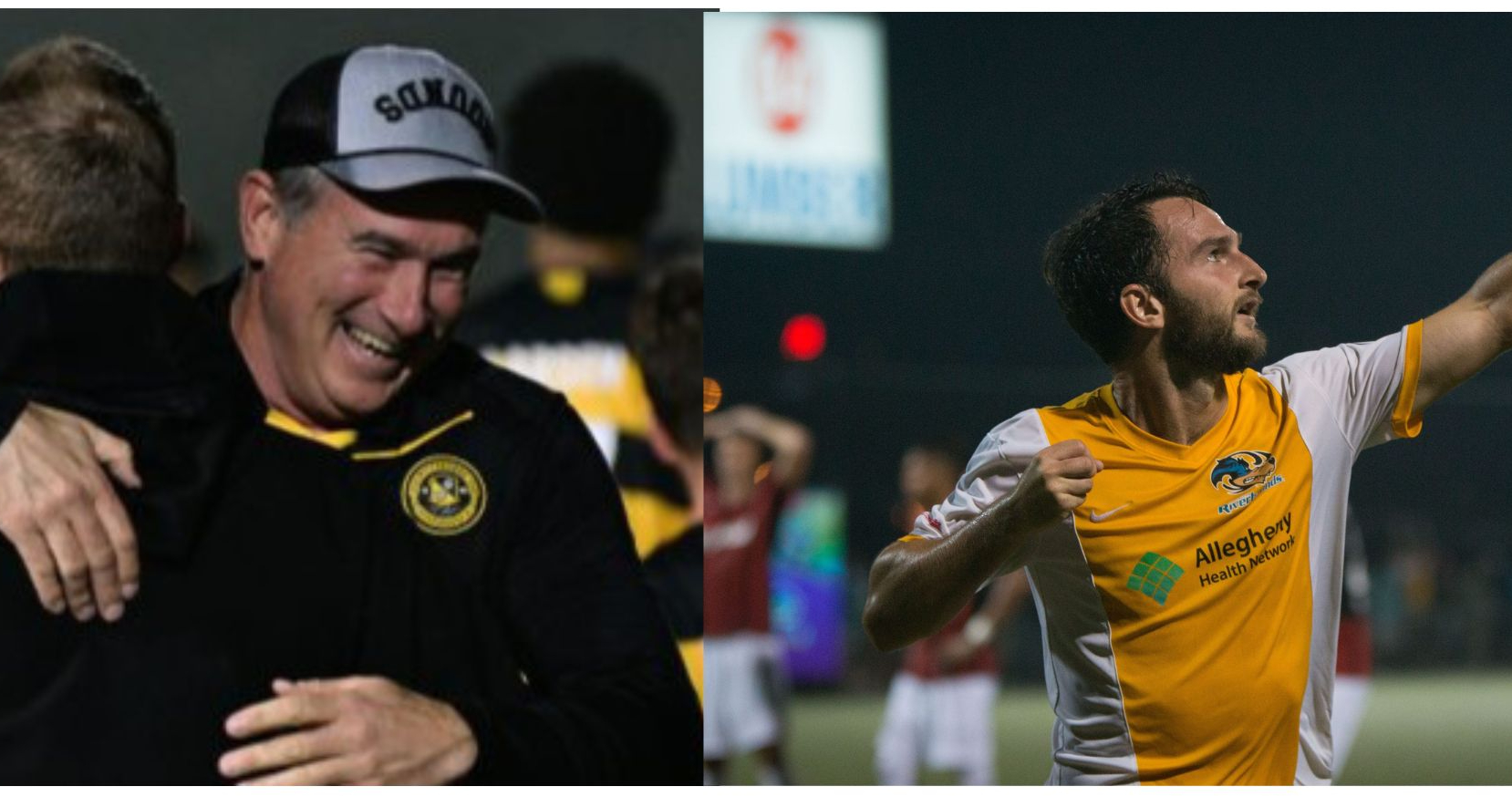
This Thursday, when the Pittsburgh Riverhounds SC formally induct owner Tuffy Shallenberger and club legend Kevin Kerr into the Riverhounds Hall of Fame, the ceremony will represent far more than a celebration of individual longevity. It marks the celebration of a rescue mission.
To truly understand why these two figures are being enshrined together, one must look past the modern amenities of a packed FNB Stadium and look back to a time when the club’s future hung by a thread in a federal courtroom 54 floors above the city.
The modern era of Pittsburgh soccer was not built on a linear path of prosperity. It was forged in the fires of a chaotic 2014 season where the club nearly died, only to emerge in 2015 as one of the most explosive, captivating teams in the country. Tuffy Shallenberger built the foundation; Kevin Kerr provided the heartbeat.
The Quiet Passion of Tuffy Shallenberger
The first time Tuffy Shallenberger made himself available to the media, it was at a press conference held between the 2013 and 2014 seasons. The Hounds were announcing the contract extensions of their breakout inaugural-season stars, Jose Angulo and Matt Dallman and a formal announcement of Shallenberger’s involvement in taking on a bigger stake in the organization. I didn’t quite know what to expect from the club’s new major investor, a successful construction business owner based mostly out of rural Fayette and Westmoreland Counties.
Out walked a man wearing a camouflage hat and jeans.
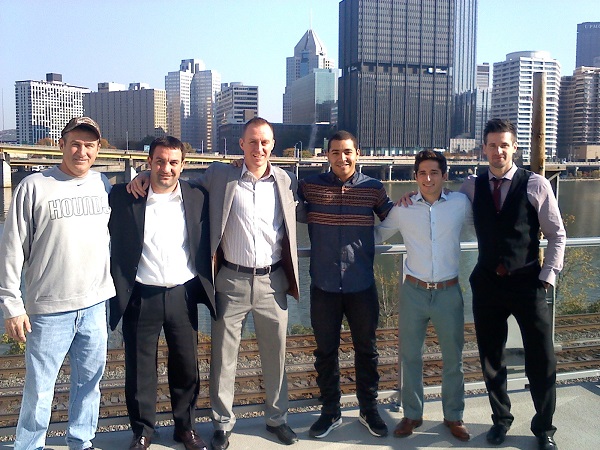
Shallenberger was extremely polite, soft-spoken, and—as he would admit when standing with a microphone in front of him on several occasions over the years—not exactly comfortable with the spotlight. Yet, he immediately made an impression.
As Rob Vincent later shared in my book, Miracle on the Mon, when Shallenberger first became involved in the 2013 season as an investor, he decided to travel to a road game in Florida. The moment he walked in, everyone in the locker room took notice. The players realized they had an owner who was actually willing to get in the trenches with them.
Over a decade of covering this team, Shallenberger has been equally present and elusive in terms of his presence in and around the club and with the media.
His passion is raw, emotional, and completely unfiltered. There have been moments where he wasn’t happy with a referee’s call, a league decision or with something published in the media—Pittsburgh Soccer Now included—and he made sure whoever needed to hear it got a passionate earful or he would ignite his Twitter/X account into action.
But that is just Tuffy.
He wears his heart on his sleeve because he has poured his life, his money, and his devotion into growing the Riverhounds organization — and ultimately — soccer in Western Pennsylvania.
You could see that emotional gravity in November 2022 at the groundbreaking of the Montour Junction Sports Complex.
Standing alongside politicians, corporate leaders, and community partners whom he had personally brought to the table, Shallenberger got visibly choked up. The complex wasn’t just a state-of-the-art home for the pro team and the Academy; it was an anchor for the community, bringing local health services to the outskirts of Pittsburgh through the Allegheny Health Network.
“You know, that was a project that was a long time in the making,” Shallenberger said.
“It takes a lot of convincing because you’re talking to people that aren’t really soccer-oriented, and so you have to convince them first of all which way soccer is going. It’s just a totally professional atmosphere. You have your kids and your youth teams practicing in the same location, everybody’s together, and it inspires the kids to say, ‘Hey, listen, I can be that person.’”
Whether it was funding a supporter bus to send the Steel Army to a road playoff match against the New York Red Bulls II in 2015, or walking into the Highmark Stadium suites with Bob Lilley at his side in November 2017 to completely rewrite the club’s competitive standards, Shallenberger has always been all-in.
When the club kept a tight lid on a very tough situation in late 2025 which saw Lilley put on administrative leave and ultimately his dismissal in favor of Vincent, who guided the team to the club’s first ever title. there hasn’t been much said — if anything — publicly about it all. One can only imagine that Shallenberger found himself in an incredibly difficult spot through that situation.
Yet, when a resilient group of players led by Vincent with the help of Dan Visser, Jon Busch and Kenardo Forbes won the USL Championship title, it felt like the ultimate, hard-fought reward for every ounce of sweat and dollar Shallenberger had poured into the badge.
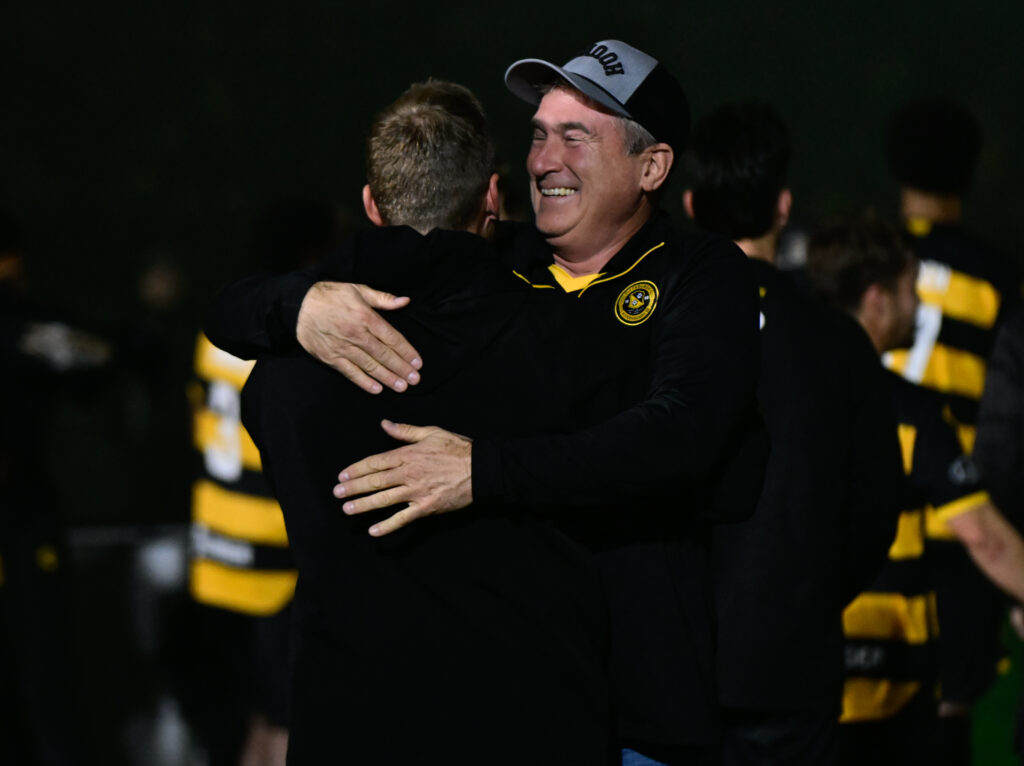
The Day of Reckoning: Reorganization
But before the championships and the complexes, the Riverhounds were on the brink of extinction.
By late 2014, the costly construction of Highmark Stadium had left the club drowning in over $10 million of debt.
Though Miracle on the Mon. chronicles the highs of remarkable comeback victory that ignited the club forward, it was critical for me to tell the other side of the story which made everything that happened afterwards possible, namely Shallenberger’s willingness to take on the organization’s finanical reorganization.
On November 6, 2014, the Riverhounds faced their day of reckoning in Bankruptcy Court. While corporate lawyers in tailored suits huddled inside U.S. Bankruptcy Judge Jeffrey A. Deller’s courtroom inside the U.S. Steel Tower, Tuffy stood out again—eschewing the tie for a plain sweater and a brown leather jacket.
Through Shallenberger Investments, he stepped up to absorb the crippling debt, personalizing the risk and pledging up to $3 million to cover projected operational losses.
At exactly 12:33:58 PM, Judge Deller confirmed the reorganization plan. Standing outside the courtroom, looking down from the 54th floor at the unobstructed view of Highmark Stadium below, Tuffy turned and said: “It’s done. We’re off and running.”
Kerr’s Standard: The Heartbeat of the Pitch
If Tuffy saved the club’s body, Kevin Kerr gave it its soul.

Kevin Kerr, Stephen Okai and Vini Dantas are hoping for same result as their April encounter with Toronto FC II. (Photo courtesy of Paul Wintruba)
The first time I interviewed Kerr was after a match in 2013. I’ll be the first to admit that, initially, I had a tough time deciphering his trademark Scottish lingo and heavy accent. But over the next decade, as I chronicled the Hounds’ new era during a time of unprecedented change in the American soccer landscape, Kevin became my one constant.
We spoke after dozens of absolute wars with the Hounds’ bitter rivals, the Harrisburg City Islanders. What always radiated from Kevin was his deep, profound respect for the supporters.
There were many moments that come to mind, but interviewing him on the dugout steps of FNB Field on City Island in August 2016 stood out for some reason.
The Hounds had just lost the Keystone Derby Cup to Harrisburg—the only time they did so during his tenure—in a grueling, disappointing season where playoffs were out of reach.
Standing there in the dark, Kerr didn’t offer excuses.
He paid tribute to the traveling Steel Army:
“We know what it is about. We know that we are not going to make playoffs this year. Every game we go out wanting to prove something to ourselves, and we also want to give back to the fans that still stand by us. They are the ones that came down tonight.”
“You could just see it on the field. During my time in football, you are going to have a good season, and you are going to have a bad season. But the one thing as a team that you never want to be called out on is your effort. Maybe we have this year, maybe we have deservedly. It is something that we desperately wanted to put right, and we wanted to put that right tonight.”
The Vulnerability Behind the “Miracle”
While Shallenberger stabilized the front office, the core midfield trio of Danny Earls, Rob Vincent, and Kevin Kerr, an Irishman, Englishman and Scotsman, forged a bond specifically in the midfield and on the pitch — and into the locker room that would carry the club out of the ashes.
When the 2015 season kicked off, the Hounds’ slashed payroll forced a reliance on collective chemistry, under the direction of USL Hall of Fame coach, Mark Steffens. What followed was the highest-scoring, roller coaster ride of a season in club history. But that standard was set by individual accountability and an immense weight of expectation that the players carried themselves.
Nowhere was this more evident than on May 30, 2015—the night forever immortalized in Pittsburgh lore as the “Miracle on the Mon.”
Down 5-3 to rivals Harrisburg City Islanders in the 90th minute, the Hounds pulled off an impossible three-goal stoppage-time explosion to win 6-5. It was Kevin Kerr who netted the dramatic, breathless game-winner, sending those who witnessed this impossible come-from-behind accomplishment into absolute delirium.
Yet, the perspective Kerr shared after that historic night reveals the true measure of the man being inducted into the Hall of Fame.
On a night when he was the ultimate hero, Kerr was privately battling immense frustration. He had a personal group of friends and family in attendance that evening, and for the first 90 minutes of the match, he felt he hadn’t performed up to his standards. He was carrying the silent, crushing weight that he had let down the people who meant the most to him.
That raw vulnerability—the fact that a player could score a historic 93rd-minute winner but immediately reflect on how he needed to be better for his teammates and his supporters—is precisely what made Kerr the emotional anchor of the club. He didn’t just care about the result; he cared about the badge, the fans, and the standard of soccer being played in Pittsburgh.

Kevin Kerr celebrates a “Miracle on the Mon” – May 2015
Kerr would finish that 2015 season with an All-USL stat line of 10 goals and 9 assists, cementing his legacy as the ultimate culture carrier who bridged the gap from bankruptcy survival to the modern, trophy-winning era in the late 2010s and 2020s.
The Intertwined Legacy
It is symbiotic that Tuffy Shallenberger and Kevin Kerr enter the Riverhounds’ Hall of Fame in the exact same class.
Their narratives are completely inseparable.
Without Shallenberger’s blue-collar grit to stand before a federal judge in a leather jacket and bankroll a dying club, Kevin Kerr would have been forced to find another home in professional soccer, and the “Miracle on the Mon” and the massive success that included Top of the Table finishes and multiple defeats of MLS opponents, filled stands and earning an elusive a league title would never have occurred.
Conversely, without Kerr’s loyalty, work rate, and emotional standard on the pitch to give that stadium a soul, Shallenberger’s financial gamble would have yielded empty seats and an uninspired product.
One man saved the club from dying in the winter of 2014; the other helped it roaring back to life in the summer of 2015 and through the rest of that decade.
Together, they are the architects of the modern era, and their names are now permanently etched where they belong—together, in the Hall of Fame.
From the PSN Archives:
For a look back at Kevin Kerr’s post-match thoughts on the dugout steps at FNB Field after that emotional 2016 Keystone Derby match, you can watch my original post-game interview on YouTube:
-
Watch:
PSN Photo Gallery — Kevin Kerr
PSN Photo Gallery — Tuffy Shallenberger


PSN’s Featured Community Partner: Open Field International



Pittsburgh Riverhounds
USL Championship Atlantic Division Preview: Familiarity breeds contempt