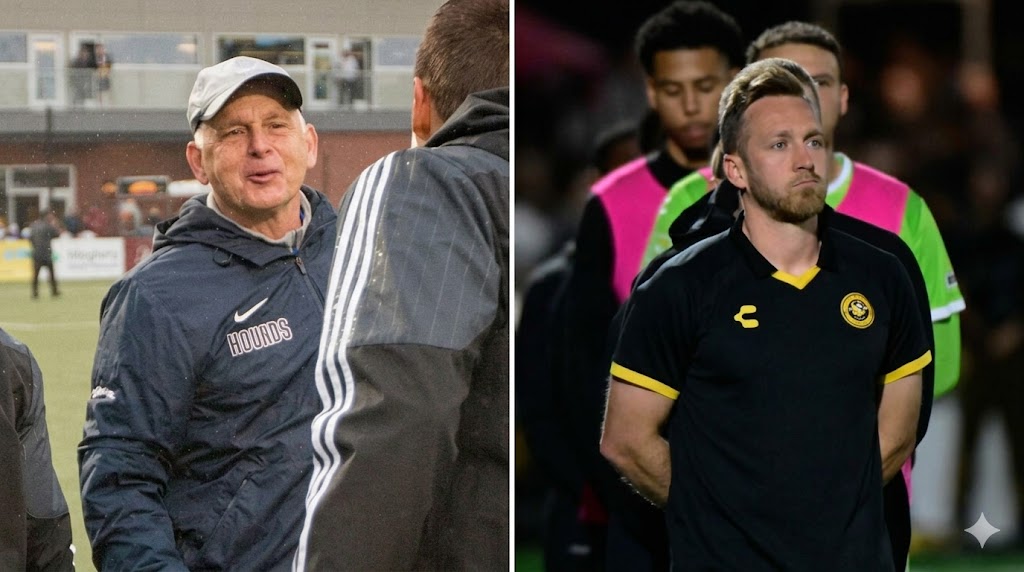
When the Pittsburgh Riverhounds kick off USL Cup play this Saturday against the Greenville Triumph, the two men pacing the technical areas will be separated but connected by a singular pedigree.
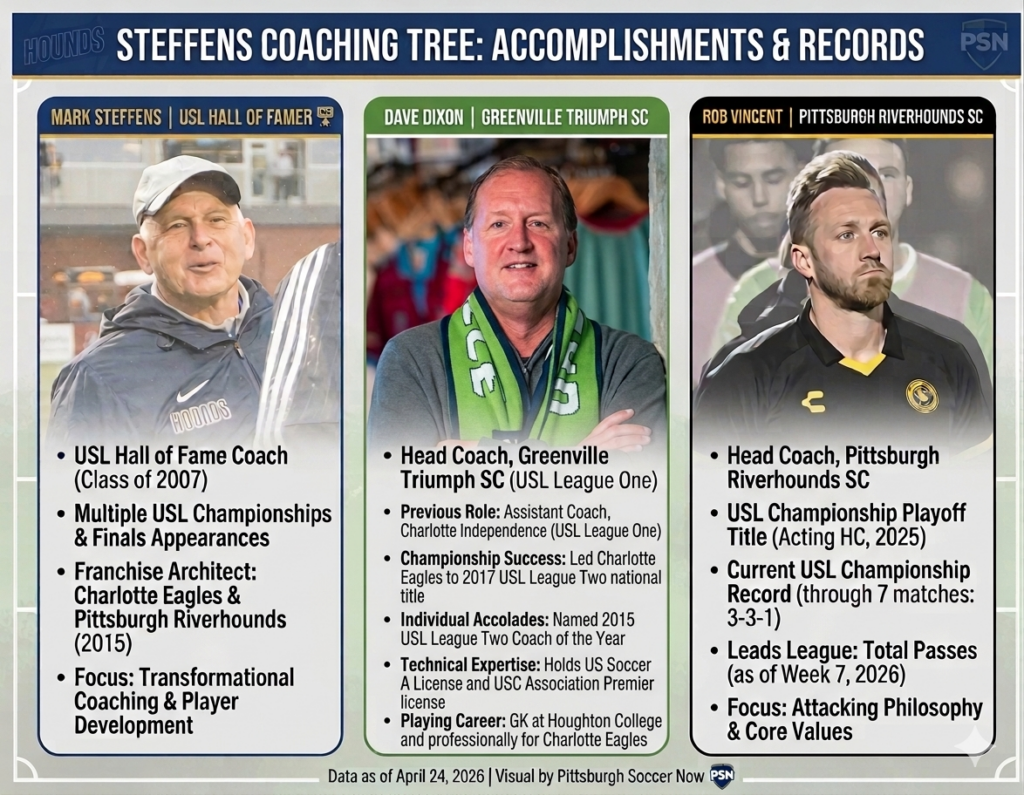
On one side stands Rob Vincent, the former Riverhounds superstar turned head coach. On the other is Dave Dixon, the tireless leader of the USL League One side, Triumph.
While their tactical approaches have evolved, both remain primary branches of the coaching tree planted by USL Hall of Famer Mark Steffens.
For Steffens, who now spends his time coaching the coaches through his Coaches on Mission program as part of Missionary Athletes International, Saturday’s matchup isn’t just a game—it’s a testament to a philosophy that prioritizes transformation over transactions.
The Transformation of a Captain
Longtime Hounds fans remember 2015 season for the Miracle on the Mon and emergence of higher scoring squad which would play in numerous remarkable, franchise transcending matches and moments, where no contest was ever over until the final whistle.
For Steffens, it was the year he unlocked the true potential of a young English midfielder.
“I saw him play against my Charlotte team (previously in 2014) and he hit a bomb from 25 yards,” Steffens recalled in an interview with Pittsburgh Soccer Now on Friday morning.
“I said, ‘No, we aren’t going to waste him as a defensive-minded midfielder.’ We put him higher up, had him cut inside on that right foot, and he blossomed.”
Vincent’s 20-plus goal season in 2015 remains legendary, but the impact went beyond the stat sheet. Speaking after last Saturday’s match, Vincent reflected on the weight of that season.
“Mark had an incredibly important role in shaping my pro career,” Vincent said.
“He came on as coach in my third season, and the way he saw the game—and the way he saw me—changed my trajectory. We still stay in touch often. He’s someone I can always pick up the phone and talk to about the challenges of this job.”
Steffens saw what he described as a cerebral leader who led by example long before he ever picked up a clipboard.
“Robbie was super intense, even if he wasn’t the most vocal,” Steffens told Pittsburgh Soccer Now.
“He hated losing a 3-v-3 match in training. You could see it on his face. He strived for excellence in every possession, and he carries that into his coaching now.”
When the Riverhounds named Vincent acting head coach late last season before their remarkable playoff run and then again when Vincent was named as Hounds’ permanent Head Coach, among first calls Vincent received was from his former mentor.
“I got on the phone and gave him a call immediately to congratulate him because he deserves this,” Steffens said Friday morning.
While Steffens was thrilled for his former captain, he admitted to being among the skeptics during the Hounds’ improbable run last season.
“I’ll be honest, even though I knew Robbie was going to do well as a coach, I didn’t think he’d win the whole thing,” Steffens chuckled.
“What a fantastic job he did. He’s extremely cerebral and mentally tough. He handled that pressure extremely well, and it didn’t surprise me that he could steady the ship during such adversity.”
Shared Roots in Charlotte and Pittsburgh
While Vincent represents Steffens’ Pittsburgh legacy, Dave Dixon represents the deep roots Steffens left in North Carolina. Dixon played as a goalkeeper for Steffens in the late 90s with the Charlotte Eagles and later returned as an assistant coach.
The two coaches are, in many ways, two sides of the same Steffens coin.
Vincent brings the attacking flair and cerebral tactical flexibility, while Dixon brings the defensive organization and relentless work ethic that Steffens demanded from his Charlotte squads.
“I texted Robbie and told him: ‘Don’t take these guys lightly,'” Steffens warned.
“Dave is a crazy recruiter—he’ll stay up until 3:00 a.m. to find the right player. His teams will be organized, physical, and they will bring it until the 90-plus minute.”
The Student vs. The Student
Saturday’s match offers a fascinating tactical contrast. Vincent has the Hounds playing a high-possession system that leads the league in passes but can be tactically flexible by its success with high press at home. Vincent’s approach leans into what Steffens implemented when he came to Pittsburgh.
On Friday morning, Steffens reiterated his sentiment when he first took the Hounds’ coaching position in late 2014, embodying a “win 4-3 rather than 1-0” mentality.
It’s been an interesting ride for the Hounds thus far under Vincent in the first full season at the helm, posting a very similar 3W-3L-1D record that Steffens’ Pittsburgh team had at as a similar point in the 2015 season.
Dixon, meanwhile, will likely bring a Greenville side that Steffens warned will be “extremely tough and organized,” looking to disrupt that rhythm.
For the man who mentored them both, the result is almost secondary to the growth of the game he loves.
“My highlight is relationship building,” Steffens reflected.
“Having coffee with young men who love the game but love life—that’s the highlight for me. Robbie deserves this success. He’s handled adversity, he’s mentally tough, and he has a very bright future.”
As the Hounds celebrate milestones for veterans like Danny Griffin and Robbie Mertz this week, they do so under a coach who was once in their boots, learning from a master architect.
As the Riverhounds lead the league in passing this year—a hallmark of the proactive, attacking soccer Steffens always favored—the real bridge between 2015 and 2026 is the team’s internal culture.
In a new era — now under a new F.N.B. Stadium banner — Vincent is intentionally weaving the lessons he learned from Steffens into the fabric of the current squad.
Steffens recalled a meeting in 2015 where he asked his team leaders—including Vincent and Kevin Kerr—to define their own core values.
It’s a practice Vincent has revived in 2026.
“Robbie told me he’s using that with the team now,” Steffens said.
“If you don’t develop the culture as a coach, someone else will, and it usually isn’t in the right direction. Being others-focused and hardworking—those simple values are what develop chemistry.”
“If you don’t lead the way in building your team culture, someone else will. Robbie and Kevin [Kerr] were a huge part of developing that chemistry back then because they owned it. Now, Robbie is making sure this team owns it, too.”
The Coachable Legacy
For the man who mentored both coaches that will step on the F.N.B. Stadium pitch, Saturday is a full-circle moment. Dixon followed Steffens as head coach in Charlotte, and Vincent has now taken the mantle in Pittsburgh.
For the two men on the sidelines, the foundation was laid more over the course of three decades by the man who taught them that winning is important—but how you build the men who do the winning matters more.
Despite being let go in 2016, Steffens speaks of his time in Pittsburgh with nothing but fondness. His departure didn’t sour his relationship with the club—in fact, he remains one of owner Tuffy Shallenberger’s biggest supporters.
“I loved my time there. I really did,” Steffens reflected.
“When Robbie and the Riverhounds won the whole thing, my first text was actually to Tuffy. We had a great relationship. I can’t say enough good things about the organization, the people I met up there, and Tuffy himself.”
Steffens continues to watch the club’s growth from afar, expressing excitement about the future of the South Shore.
“I’m so excited that they’re going to be expanding the stadium,” he said.
“What a great stadium that is. I have a lot of positive thoughts about Pittsburgh. I just wish the organization continued success.”


PSN’s Featured Community Partner: Open Field International



Pittsburgh Riverhounds
USL Championship Atlantic Division Preview: Familiarity breeds contempt