
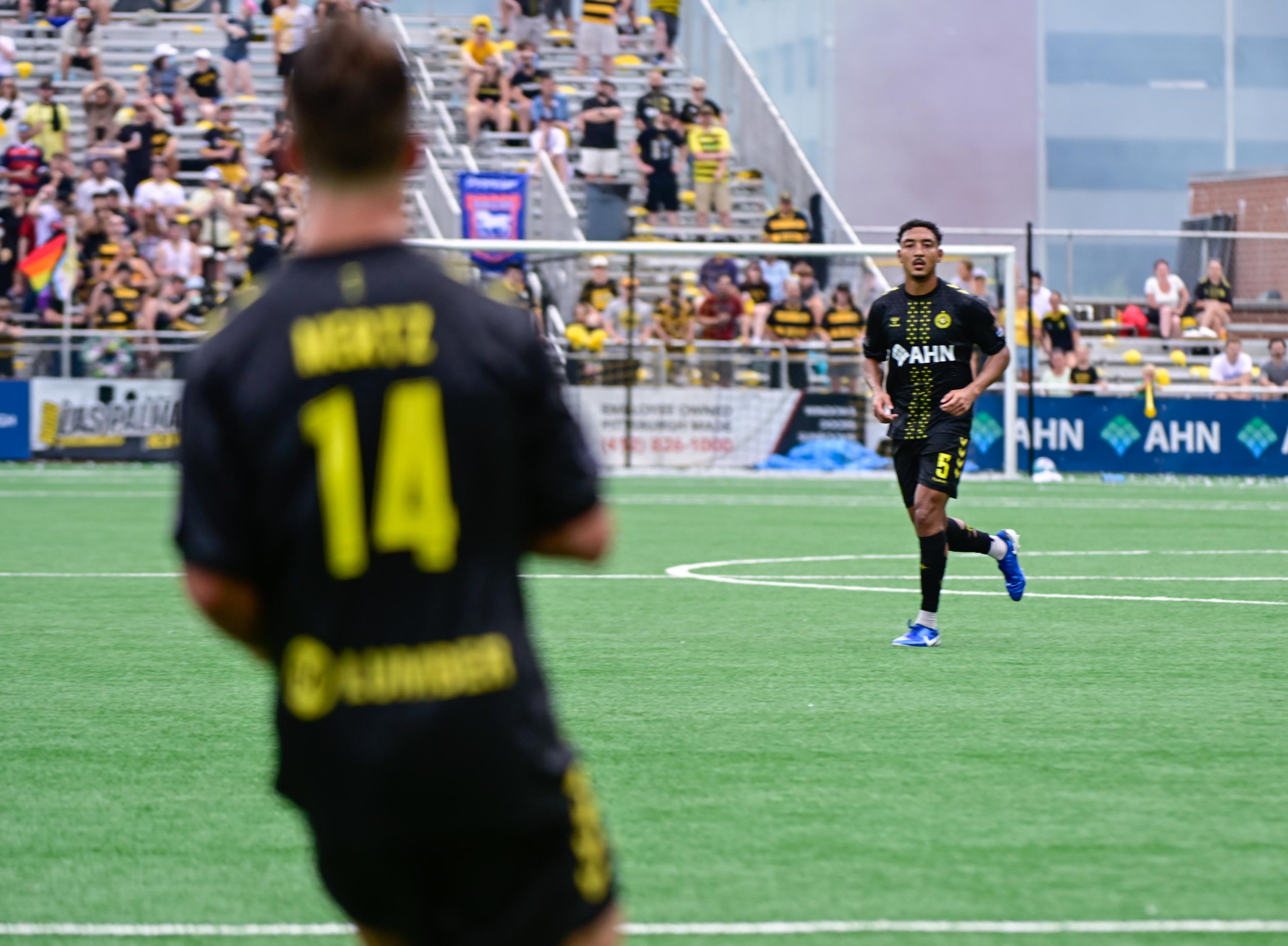
Through 19 matches of the 2026 USL Championship season, Pittsburgh Riverhounds SC sit at 8W-8L-3D (27 pts), holding firm in 5th place in the Eastern Conference. On paper, it is a stable, competitive campaign that keeps the squad well within reach of hosting a home playoff match.
Yet, when listening to head coach Rob Vincent throughout his first full year at the helm, there is a clear tension between intent and execution. Vincent has expressed confidence at multiple checkpoints that his squad has established a distinct identity—one focused on being braver in possession, dictating matches, and sustaining territorial pressure. On the pitch, however, finding the operational consistency to match that vision has been an ongoing pursuit.
A look at the underlying metrics—both at the team level and across individual performances—reveals a fascinating picture of a club in transition: elite off-the-ball habits, a heavy reliance on defensive workhorses, and a glaring lack of final-third punch.
Part I: The Team Profile — Defensive Steel vs. Attacking Friction
When breaking down the league-wide team rankings, the statistical duality of this Riverhounds squad becomes immediately apparent.
When asked about this after Thursday’s training, Vincent was fully transparent with his club’s strengths and shortcomings to this point this season.
“Look, the data doesn’t lie—defensively, the foundation is solid. We’re organized, we restrict high-quality chances, and we’re disciplined on set pieces,” Vincent stated.
“But we know the attacking metrics need to come up. Creating more big chances and getting more touches in the box isn’t just about tactical tweaks; it’s about decision-making and execution in the final third. We’re working on getting more bodies into dangerous areas and being more decisive when those moments arrive.”
1. The Defensive Engine Is Still Elite
While former defensive anchor Sean Suber took his talents to Saturday’s upcoming opponent (the Charleston Battery), the structural principles that won Pittsburgh the 2025 USL Championship title remain intact.
-
Set Piece Discipline (2nd in USL — 2 Goals Conceded): Pittsburgh remains one of the absolute hardest teams in America to score on via set pieces, trailing only Lexington SC.
-
High Turnover Generation (5th in USL — 3.5 Possession Wins in Final 3rd/match): The Hounds still work relentlessly off the ball. They trigger presses effectively and win the ball back deep in opposition territory at a top-five rate in the league.
-
Work Rate & Clean Defending (4th in Clearances [26.3/gm], 5th in Tackles [14.3/gm]): The backline is constantly active, yet immensely disciplined. The Hounds rank 23rd in fouls per match (11.6) and 25th in yellow cards (22). They do not give away cheap set pieces or dangerous restarts.
-
Saves Per Match (17th — 2.2/gm): Nico Campuzano isn’t being forced into heroics every night because the defensive shell in front of him restricts high-percentage central looks.
2. The Attacking Ceiling Remains Capped
The flip side of the data explains why the Hounds sit dead-even with a 0 goal differential (20 scored, 20 conceded).
When Vincent talks about ‘dictating matches’ — the numbers show a team still playing catch-up to the league’s elite:
-
Creation Void: Ranking 22nd in Big Chances (29) and 22nd in Corners (61) underscores a team that struggles to generate sustained pressure in the final third. They rank 19th in touches inside the opposition box (321)—nearly 200 touches behind league-leading Louisville (513).
-
Cross & Service Deficit: Sitting 21st in accurate crosses (3.4/gm) explains why central strikers often have to work on island conditions.
-
Capitalizing on Chances: Interestingly, Pittsburgh ranks 24th in Big Chances Missed (16)—not because they are clinical, but because they simply do not generate a high volume of high-percentage opportunities to begin with.
-
Conversion Rate (T-13th — 14%): Despite the lack of volume, the Hounds aren’t completely wasteful when they get into scoring areas. Their 14% conversion rate sits right in the middle of the pack, reinforcing the idea that volume and creation—not necessarily finishing quality—are the primary culprits behind the 20-goal total (20th in USL).
- Pass Volume (4th in USL) vs. Pass Accuracy (20th in USL): The Hounds are heavily involved in recycling play—frequently circulating the ball between Campuzano, Souza, Kelp, Griffin, and Wälti. This was something addressed by USL Championship’s Lead Broadcast Analyst, Devon Kerr, when he was on Sounding Off on Soccer Podcast a few weeks ago. However, ranking 20th in accuracy highlights that when Pittsburgh attempts to transition from safe circulation into progressive, line-breaking passes, the execution breaks down. They rack up total passes, but too many turnovers occur when trying to force the ball into tight central pockets or forward channels.
Part II: Individual Deep Dive — Where Is the Standout Performer?
During last year’s championship run, Sean Suber provided a historic individual anchor on his way to All-USL First Team honors—setting a single-season club record with 204 clearances while winning 62.3% of his 183 duels. In goal, Eric Dick delivered an iconic playoff MVP stretch with four consecutive postseason clean sheets.
In 2026, there isn’t a single All-USL runaway candidate on the roster, though the same thing could’ve been said for last year at this time too. Instead, the workload has been distributed across a handful of key contributors.
The Attack: Work Rate vs. Efficiency
-
Albert Dikwa (6 Goals, 2 Assists, 8 G+A): Dikwa’s value to Vincent’s system goes far beyond the scoreline. While he hasn’t matched his blistering 2023 MOP scoring pace, his engine is invaluable. He presses high for 90 minutes, checks down to extend possessions, and link-plays. However, efficiency remains a question mark: Dikwa leads the squad with 8 big chances missed.
-
Trevor Amann (5 Goals, 0.73 Goals/90): Amann is, by a wide margin, the most efficient lethal finisher on the roster per minute. While three of his five goals arrived during his historic hat-trick performance in July’s 3-1 win over Louisville, his 3.2 shots per 90 and 1.0 shot on target per 90 lead the team. Finding ways to get Amann and Dikwa service in tandem remains Vincent’s biggest tactical puzzle.
-
Eliot Goldthorp (1.2 Shots on Target/90, 0.9 Dribbles/90): Goldthorp has been the team’s most direct wide threat. He leads the squad in shots on target per 90 minutes and successful dribbles, offering the brave, risk-taking profile Vincent has publicly called for.
Vincent addressed this after Thursday’s training: “We want Eliot and our wide players to be brave and take defenders on—that aggressiveness is necessary if you want to break teams down. But the next step in their evolution is recognizing when to shoot versus when to connect that final pass or pull-back. It’s a fine balance between individual flair and team efficiency, and that’s something we’re constantly refining in video sessions and on the pitch.”
Sam Bassett started off the season showing impressive flashes where he could be a dynamic presence in linking play between the central midfielders and into the final third, but an injury derailed his presence and it seems as if he’s been struggling since to have the same impact he had when scoring a few nice goals from distance and providing a relentless work-rate underneath and at times along side Dikwa and Amann.
The Unsung Creators & Midfield Anchors
-
Perrin Barnes (4 Assists, 5 Big Chances Created): Barnes has quietly been the Hounds’ most effective final-third engine. Despite playing in a hybrid winger role as part of back line, his five big chances created and four assists lead the entire team, making him a crucial asset out wide. Max Viera has slid into the right back / winger role in the past few matches, adding an assist in the win at Oakland, so it will be interesting to see how the competition for this spot will evolve.
-
Robbie Mertz (19 Chances Created): Created): Mertz remains Vincent’s most reliable creative engine in open play, with 19 total chances created, but his overall pace is slightly behind his 2025 production. Part of this stems from line-up rotations and positional shifts as Vincent has experimented with different wide and central combinations.
-
Danny Griffin (1,491 Mins, 45.2 Passes/90) & Jackson Wälti (40.2 Passes/90): The central midfield tandem provides the structural spine. Griffin leads all outfield players in accurate passes per 90, acting as the primary distributor in transition.
The Defensive Pillars
-
Lasse Kelp (7.44 FotMob Rating): Kelp has been the highest-rated player on the team according to algorithmic match metrics. Leading the club in accurate long balls per 90 (2.8) while anchoring the left side of the defense where as Vincent changed tactics, moved Kelp to an outside back role. Kelp’s defensive efficiency has been a big factor in filling the statistical void left by Suber’s departure.
-
Owen Mikoy (7.04 Rating) & Joao Victor Souza (1,526 Mins): Alongside Kelp, Mikoy and Souza have formed the defensive central core. Souza ranks second on the team in minutes played (1,526) and second in accurate passes per 90 (44.9), proving essential to Vincent’s build-up play from the back.
-
Nico Campuzano (1,710 Mins, 6 Clean Sheets): Playing every single minute of the league campaign, Campuzano has provided absolute stability between the posts, posting 6 clean sheets and commanding his box on set pieces.
The reason Kelp and Mikoy don’t sit near the absolute top of the league’s aggregate defensive leaderboards (clearances, tackles, interceptions) comes down to availability early in the campaign. Early-season injuries to Guillaume Vacter and Beto Ydrach delayed their insertion as regular starters until four or five matches into the schedule. On a rate-adjusted basis (per 90 minutes), both have performed at an elite standard.
“Yeah, obviously at the start of the season we had Beto and Guillaume out there doing a great job, but injuries happen in soccer,” Kelp shared.
“When Owen and I got our chance, we just focused on communication and keeping things simple. Having Victor and Nico behind us makes a huge difference—Nico’s voice from the back keeps everyone organized for 90 minutes. We pride ourselves on being hard to break down, no matter who is in the lineup.”
Had both Kelp and Mikoy played from Matchday one, their aggregate defensive numbers would likely put them near Sean Suber’s 2025 pace. It will also be interesting to see what happens when Vincent has a healthy room full of center backs. Vacter has been back training and available for selection, while Ydrach is also close to his return. Chemistry is a very important piece to an efficient back line. Right now, the current grouping has been working well together and Vincent likely won’t be changing too much.
Part III: The Intangibles — Veteran Leadership & The Culture Bridge
While spreadsheets and heat maps lay bare the structural realities of this 2026 Riverhounds squad, metrics only tell half the story. The ultimate success of Rob Vincent’s tactical transition hinges on an unquantifiable foundation: veteran leadership, culture, and locker-room standard-setting.
This year’s roster is largely young and navigating a steep learning curve. Shifting from the rigid, defensive-first, low-block counter-attacking principles that defined the Bob Lilley era to Vincent’s more expansive, proactive vision requires immense mental discipline. It is an evolution that could easily cause a squad to lose its way when results fluctuate.
That the Hounds have maintained their competitive floor—holding firm in 5th place during this transition—is a testament to the core of veterans bridging the gap.
The Standard Bearers: Griffin, Mertz, Dikwa and Etou
Danny Griffin (1,491 minutes played) and Robbie Mertz are the foundational pillars of modern Riverhounds soccer. Both were instrumental in executing the disciplined, grit-heavy Lilleyball framework that elevated Pittsburgh from a mid-tier club into one of the standard-bearers of the USL Championship.
Adapting to a new system while maintaining the winning culture they helped build is no small task.
-
Griffin continues to set the benchmark for work ethic. Whether circulating play (45.2 passes/90) or shielding the backline, his relentless engine and accountability give the younger players a daily blueprint for what it means to wear the badge.
-
Mertz provides tactical intellect and emotional poise. Even as his open-play chance creation (19) sits slightly off his 2025 pace during system adjustments, his voice and steady demeanor keep the squad grounded through match-day turbulence.
-
Albert Dikwa: When Trevor Amann exploded for his historic hat-trick against Louisville in July, he credited much of his development to the extra hours spent before and after training with Dikwa. Known across the league for his legendary work rate, Dikwa’s willingness to embrace the unglamorous tasks—pressing high for 90 minutes, checking down, and mentoring fellow strikers—defines the team-first culture.
-
Junior Etou: The club’s oldest player, Etou brings a quiet, selfless reliability. Capable of putting in grueling shifts anywhere along the flank, his willingness to sacrifice individual highlights for tactical structure reinforces the squad’s blue-collar identity.
-
Behind the established veterans, Jackson Wälti is rapidly establishing himself as a steadying force in the central pivot. Wälti knows a thing or two about driving a winning culture—having captained the Pitt Panthers to multiple College Cup appearances. His tactical awareness and calm presence under pressure allow Griffin the freedom to roam and break up play. Following Saturday’s match, Wälti highlighted the critical role the veteran core plays in keeping the team aligned as they fine-tune their new identity.
“Guys like Danny [Griffin], Robbie [Mertz], and Albert [Dikwa] are the heartbeat of this club,” Vincent added.
“They spent years executing a specific system very successfully, so asking them to adapt to a slightly different approach requires trust. Their leadership in the locker room has been vital. They lead by example, they keep the group focused, and they ensure that our core culture of grit and hard work never waivers while we build out the tactical side.”
Leadership isn’t always about armband duties or pre-match speeches; often, it’s forged in the extra reps on the training pitch.
“The standard they set in training every day is unbelievable. Even on days when things aren’t clicking in the final third or results don’t go our way, Danny and Robbie are the first ones pushing the tempo in drills, and Albert’s work rate sets the tone for everyone,” Kelp added.
“For younger guys, seeing that level of commitment makes it impossible to drop your head. They keep us accountable to the Hounds standard.
The Bottom Line
Tactical identities can be drawn up on whiteboards, but culture is built in the trenches. As the Riverhounds enter the final stretch of the regular season, the tactical metrics may still be a work in progress—but the squad’s mental foundation remains as rock-solid as ever.
Part IV: The Notebook Verdict
When you stack the team stats against the individual metrics, the narrative around the 2026 Riverhounds becomes clear:
-
The Floor Is Secure: Thanks to the defensive discipline of Kelp, Mikoy, Souza and the pressing work led by Griffin and Wälti in the mid-block, and Dikwa leading the line, this team will rarely get blown off the pitch. They don’t concede set-piece goals, they don’t commit silly fouls, and they don’t give away soft chances.
-
The Identity Crisis Is Attacking: The reason Pittsburgh struggles to string together wins isn’t a lack of effort—it’s a lack of volume in the final third. Sitting 21st in goals (1.1/gm), 22nd in big chances, and 19th in touches in the box shows that the transition from a defend-and-destroy team to a possess-and-dictate team remains a work in progress.
-
The Charleston Test Awaits: Hosting the 2nd-place Charleston Battery on Saturday, Aug. 15, provides the ultimate barometer. On the opposing sideline sits Sean Suber and a Battery squad that leads the USL in goals per match (2.0), possession (55.8%), and big chances (57).
If the Hounds want to turn their 5th-place standing into a genuine top-four push, the second half of the season must be about bridging the gap between their elite defensive foundation and a bolder, more aggressive attacking output.
Special thanks to PSN’s intern, Kevin Hutchinson, for his interview sessions with Vincent and Kelp. Those full interviews can be found on Pittsburgh Soccer Now’s Instagram. Look for a Match Day Preview that will break down Saturday’s contest in more detail to come late Friday or early Saturday.


PSN’s Featured Community Partner: Open Field International



Pittsburgh Riverhounds
USL Championship Atlantic Division Preview: Familiarity breeds contempt


